Showing posts with label Pythagorean Theorem. Show all posts

Saturday, November 19, 2016

Pythagorean Short Stacks

     Last year I taught an 8th grade collababorative math class. My class consisted of 12 special education students with IEP's, 4 students with 504 plans and 12 general education students who scored between 2nd and 4th grade level in math. I also had a special education teacher and teacher assistant to help in the classroom. This was truly the most challenging class I have ever taught. Trying to cover the standards with such a diverse group took lots and lots of planning. 

      My favorite unit with this class was Pythagorean Theorem. They really understood  it! In my Algebra and Pre-Algebra classes I used my Pythagorean Stack activity. See my previous post on Pythagorean Stacks here.  I knew this would be too difficult for my collab class to do so I adapted it and created my Pythagorean Short Stack activity for this group. It has less problems and they still have to find missing sides which makes both of these activities so much fun. All of the answers are integers just like the Pythagorean Stack Activity so you can tell the students there are no decimals or fractions. They loved this project and did a great job. The room was buzzing with activity as they worked in their groups helping each other.


(Not drawn to scale)

     I did add in numbers for each of the triangles to make it easier to grade. On the other activity if they didn't number the triangles it was difficult to follow. I know a black and white version would print better but the colors cover up a multitude of mistakes on my diagram. Believe it or not I used Word to make this. My son just looks and me and rolls his eyes and says, "Mom why don't you use paint for that?" I guess I'm just old school. What can I say.

     This year I plan on using both activities with my Pre-Algebra as I have many struggling students in these classes as well. 

     My Pythagorean Stack post is one of my most popular posts so I'm hoping that many of you will find this to be fun to use in your classes as well. Enjoy!

Download file here:   Pythagorean Short Stack

Til next time,

Jan

Friday, July 10, 2015

Pythagorean Stacks

I absolutely love this post from great maths teaching ideas for a  trigonometry-pile-up. However, I don't teach trigonometry in my 8th grade math classes but I do teach Pythagorean Theorem. I decided to make triangle stacks that cover this topic. The first unit for my Algebra students is Pythagorean Theorem. It isn't a topic we usually cover in Algebra but the students are eighth graders and they will be tested on this material so we will cover it at the beginning of the year. Toward the end of the school year I will use this activity with my Pre-Algebra students as well. 


Silly students, don't look for answers here. You will not find them as I don't post answers that can be copied. 
(The diagram is definitely not to scale.)
The correct worksheet is the downloaded copy. It has the corrections. Sorry for the confusion. I need to update that picture one of these days. 
All of the answers are integers so I may use this in conjunction with the Pythagorean Triple lessons that I will be doing with the students. Students will place numbers in each of the triangles starting at the bottom so it will be easy to follow their work. They willstart at the bottom of the puzzle to find answers and work their way up to the top triangle to find the missing side. I plan to have the students place this in their interactive notebooks.

I can't tell you how many times I made this diagram. I thought it was perfect until the area where the green, blue, yellow and purple triangles intersect. I was 1 cm off, Yikes! So I adjusted the picture and hope you understand what it means. All in all I am very pleased with how it turned out. It will be interesting to see how it works with the two different groups of students. My concern is that it will be too easy for the Algebra kids but too hard for many of the Pre-Algebra kids. I'll let you know.

Click here to download the Pythagorean Stacks worksheet.

Hope you all are enjoying your summer! School starts in one month for us. Too much planning to do and so little time. UGH!


Til next time,
Jan

Sunday, May 10, 2015

How can we correct the scarecrow? (Adapted R. Kaplinsky lesson with a Colin Dodds video too!)

     My 8th grade Pre-Algebra students have been working on our Pythagorean Theorem unit for a couple of weeks. Today when the kids walked into the room I turned on this short video by  Colin Dodds.   I told them to pay attention to the vocabulary in the song because they would be using it in today's lesson.  We have been using this vocabulary all along but this gave great visuals as well as music to help them remember the words. I did add my input when the song said the two other sides, I asked, "What is the vocabulary word for those two other sides? The kids love all of Colin Dodds' songs.


    Robert Kaplinsky has an amazing site and if you haven't seen it before you are in for a treat.  One of the lessons that he has listed for the 8th grade Pythagorean Theorem Standard is, "How can we correct the Scarecrow?," from the Wizard of Oz.  I asked the kids how many of them had seen the movie. Only about half of my students had seen it. WHAT!!! I was shocked. Of course, they all wanted to watch it right then and there but no - not today. So we talked about the Scarecrow and how he gets his brain and tries to recite the Pythagorean Theorem but gets it mixed up. As I have told you before the majority of my students speak another language so I knew I would need a visual on this part of the lesson. I made a template for them to fill for this activity so they had a little direction. (The download is at the end of this post.)


     We watched the Scarecrow and together wrote down what he said. It took about 4 times repeating the video to get the whole statement. Working in their groups the students needed to find the Scarecrow's  mistakes, write them down, and correct what was wrong. I told them that I found 5 mistakes and challenged them to find them all. Believe it or not, you could hear crickets in the room (that means it was really quiet for my second language friends). They looked at me with big eyes as I walked around waiting for me to tell them the answer. Nope, that is not happening. 

    Me: "What is something that the Scarecrow said that was wrong?" Luckily the isosceles triangle was one that they could see right away so that gave them some encouragement. After a few minutes I heard isosceles triangle, hypotenuse, legs and so on. I told them I like the math vocabulary I was hearing.

     After they found the mistakes they were to write down what the Scarecrow should have actually said. 
Me: " No you cannot write a2 + b2 = c2. You need to write a statement using the math vocabulary we have learned in this unit."  There was a lot of groaning at this point from many of them.

     Here are some examples of the students work. Sorry if it is hard to read, they use mechanical pencils are light and difficult to read.


     When the kids wrote down the quote from the scarecrow, I didn't write it, I only repeated it. Being a math person I just assumed that the students would know he was talking about  "the sum of the square roots" not, "some of the square roots." I clarified that with my other two classes.

     I think that hypotenuse and hypothesis from science became a new word here. You will see how my kids struggled using the correct vocabulary for this activity.


   So many students thought that some was a mistake and that sum was the correction. I think next year I will write out with them what the Scarecrow actually said. 


We have been using the words squared and square roots all year. How can they not understand the difference? I had no idea this was an issue for so many of them.


Almost correct.


    At the very beginning of the video clip the Wizard says he has his Thd, Doctor of Thinkology Degree. Many of the kids didn't understand the reference and believed it was a mistake and should be Phd. That was not something I thought about but it made sense.

     The template I created was taken from one we used in the past for the extended response problems that were part of our state testing. It was called a 4 square template. The top left box is where the students would write,  What I know. The bottom left was where they would show their Work, the bottom right is where they would Explain their work and the top right box would say, My answer is ... and they would circle their answer. It was a good template but we can't use it anymore because the students need to write their responses in paragraph form. Too bad, it was a great tool for them and I do use it for lessons like this.

     We used the entire 45 minute period to do this lesson. One of my classes had to watch Colin Dodds video and extra 3 times to listen and look at the vocabulary again.

     Another class was able to finish so I collected the paper and found "my  favorite no." The next day I went over "my favorite no" with the other two classes as well. I use this quite a bit in my classroom. Watch the video from the Teaching Channel which explains "my favorite no" better than I ever could. I do believe they understood the difference between when to write squared or square root when we went over the favorite no's.


      Last year I tried this lesson by just watching the video and it was confusing for my students. Having the kids write down what the Scarecrow said and doing this activity at the end of the Pythagorean Theorem Unit made a big difference over last year. There was still confusion on the difference between the vocabulary words square root and squaring a number. They knew the difference between the computations but not the words. I think having to struggle rewriting what the Scarecrow should have said was a great learning experience for them. I had fun watching them when they started finding the mistakes and how they were interacting in their groups. They did a great job. It was a GOOD DAY and you have to sit back and enjoy that when those days happen. I'm smiling.

Download document


Til next time,
Jan

Friday, April 18, 2014

Pythagorean Triple Foldable Booklet

     I wanted to find some work for my students to do on Pythagorean Triples this year. In the past triples were two questions in the math book. I discovered there really isn't much out there especially for 8th grade. I knew that I wanted the kids to understand that you can multiply triples by a factor and another triple is the result. I also want them to know the slopes of a family of triples are equal. Reviewing perimeter and area seemed like a good idea. They never understand that if you double the sides of a figure that the area does not just double.So here is the booklet I created.


     When you cut this booklet, do not cut on the lines. I had a hard time getting the pages to line up perfectly. I don't know why. So I just made a large margin all the way around when I cut it out. It still turned out looking nice.


      I like to use graph paper and have students create graphs and tape them into their foldable. At the beginning of the year we have each student bring in a packet of graph paper to their math teacher. We keep the graph paper in the classroom and pass it out as needed. That way the kids don't have to carry it around or forget to bring it to class. I keep a bin on the back table and they can take what they need even if it is for another class. I always have plenty on hand to last the year. And as you know, I save the scraps to be used later.


Click here for a copy of the  Pythagorean triple booklet.


       Now here comes the funny part. I was trying to figure out how to print the pages, front and back to make the booklet. I spent a long time working to get the pages in the right order. Finally, I just gave up. The next day I was talking to Gina, the math teacher across the hall from me and a young techie. I told her my frustration with trying to get the booklet together. She told me that if you save the word document as a pdf, which I do, when you go to print there is a button that says booklet. What? Who knew? Oh my gosh, it just puts the pages in the correct order to make the booklet. (Don't judge me, I was clueless!) So anyway, if anyone out there doesn't know this, when you go to print the booklet, click on booklet. How simple is that?
     This turned out to be a wonderful lesson with the class. It did take two periods for us to assemble and fill in the booklet. It was a great review of several different topics as well. Hope you enjoy it.

                                                               Til next time,
     
                                                                     Jan


Perfect squares and square roots

     In a previous post I shared the flash cards that I had students make to memorize their perfect squares and square roots to 25.


Click here to see flash cards for perfect squares and square roots (make sure to download the document to see square roots as well) and the previous post.

     In the past I have had limited success with this because some of the kids would not take home or look at their flash cards to study. Well this year I tried something different. Even though I only have my students for 45 minutes a day, I have them pull out their flash cards and take the first 4 minutes of class to study them individually. Then they work with their partners for 3 minutes each quizzing each other on their facts.   Then they put their flashcards away and we orally recite the facts. I say 1 squared they say 1 and so on. This 10 minutes a day has helped them tremendously. We are working on Pythagorean Theorem and the kids are seeing the benefit of knowing their perfect squares by heart.
     Some of my lower level students forget their cards, I think because they don't know them and are embarrassed to work with their partners. I work with them in a small group during that 10 minutes. It has helped them to have the individual attention and we go over some of the square roots orally together. They really like doing this and they are learning some of these facts.
      Next week I will be calling each students aside and checking to see how many they know. The students who have them all memorized, so far about 8 out of 87 Pre-Algebra students will have their name put on the wall of perfect square masters. I will have to find something else for them to memorize during our 10 minute period. And as if I am not nerdy enough, I am teaching the students this song to the tune, "We will,  We will, Rock you."  They clear off their desks and do the:
pound, pound, clap -
on their desks to the song.

Here are the lyrics:

I know my squares
up to 25,
and I'm going to say them,
for you right now,
and if you think I can't,
that's a BIG MISTAKE!
we're squaring numbers,
all over the place.

Refrain:
We will, we will, square them!

Me:   Ready, set, 1, 2, 3, go:  1 squared
Kids: 1
Me: 2 squared
kids: 4
Me 3 squared
kids 9
... do this to 10 squared.

Refrain:
We will, we will, square them!

Me:   Ready, set, 1, 2, 3, go:
Me: 11 squared
kids: 121
Me 12 squared
kids: 144
... through 15 squared.

Refrain:
We will, we will, square them!

Me:   Ready, set, 1, 2, 3, go:
... squares through 20.

Refrain:
We will, we will, square them!

Me:   Ready, set, 1, 2, 3, go:
squares through 25

I know my squares up to 25,
I just said them for you right now,
I told you I could,
I made no mistakes,
we're squaring numbers,
all over the place.

Refrain:
We will, we will, square them!

     I am here to tell you that the kids love this and come in everyday asking if we can do the song. Everyone is exhausted by the end of the song and shaking their hands, but they are all smiles. I do have to talk to the teachers in the rooms near me to see if they are testing because we make a lot of noise. My students who need movement have had their sensory input for the next couple of hours and my visual and auditory learners have used their senses as well. A win, win situation. I do lead the pound, pound, clap - at the front of the room to keep the beat the same. Maybe one of these days I will actually be able to record a class doing this.

                                                  Til next time,

                                                        Jan


Saturday, March 29, 2014

A peek at my Pythagorean Theorem Unit

      At last, my finalized Pythagorean Theorem unit. I feel like I have been working on this forever. I love all of the activities that I have found and it was difficult to narrow it down to the following lessons. Here is a list of the major activities that I am doing with my students starting next week. This is going to be fun!
     

Pythagorean Theorem Investigation

     I will introduce Pythagorean Theorem with the Starburst candy activity. I was inspired by Pam Lucken's video to use Starburst candies as a manipulative to form the sides of the triangles. I have seen the same project using other manipulatives as well. I just think candy will be fun. My goal is for the students to be able to discover the Pythagorean Theorem on their own. When they have finished the activity it will go in their interactive notebooks.

Students will need:
  •   A copy of the Starburst Triangle Investigation and direction sheet.
  •  A plastic bag with 340 Starbursts in each bag. (Maybe 350 to account for accidental eating.) 
  •    A plastic bag with triangle measurement sides for the six triangles they will model.
  •    Paper, pencil and straightedge.    

                                                   
Click here for: Starburst triangle investigation and
Triangle Exploration Worksheet ( adapted from Alexander Sabitino, Picking Pythagorus.)
Directions for Starburst Exploration, Starburst triangles to measure pg 1, 
starburst triangles to measure pg 2


         My students will follow the directions on the Triangle Exploration worksheet and create triangles with the side lengths given on the cards in their envelopes. They will determine if the sides form a triangle, classify what type of angle is formed by the largest angle and if the area of the smaller sides cover the largest side.

Pythagorean Theorem Foldable

The next day we will make this foldable and place it into our INB'directions for Starburst activitys.


Click here for Pythagorean Theorem foldable template.

Interesting Lessons

     Time for some interesting problems from Mrs. Hester's Classroom and Embrace the Drawing Board. Check their entire lessons on the link provided. I love these two lessons.


And here are some more wonderful INB pages from Mrs. Hester's Classroom.


Lesson Will the TV fit, from Tim's 3 act from Embrace the Drawing Board.

Pythagorean Triples

    In the past, Pythagorean Triples have been one or two problems where the topic has been mentioned and not much more. I plan on spending a few day on triples this year.


     OK, I don't have this foldable completely finished but thought I would give you a preview. Final foldable will be posted soon. Promise!


And here are some videos.

     I love Robert Kaplinsky - Wizard of Oz, Pythagorean Theorem problem. See if you can find all the errors in the video before looking at his answers. I can't believe that so many of my students have never seen this movie. I may be dating myself but we watched it every Thanksgiving when we had only 4 channels to watch on TV. My how times have changed.

       Some teachers would probably use this at the beginning of the unit, but I want my students to have lots of practice with Pythagorean Theorem before they see this video. I am going to use it at the end of the unit. They will have practiced many times and be able to verbalize or write down the errors they see.


And of course, Dan Meyer's 3 act, taco cart lesson. Check his site to see all 3 acts with questions and more. It is outstanding and the kids love guessing to see who will get to the taco cart first.

Distance Between Two Points 

     I'm excited to use Mary's lesson distance between 2 points at Curiouser and Curiouser. Read Mary's post to see the rest of the lesson. I'm hoping that the hallway outside my classroom is large enough for this. If not I will go to the main hall of the building. I like how the students will need to decide how to measure the sides. I've already started to think about how to group the students for this activity so they will be successful. Thanks Mary for posting this lesson.


     I know that I will  add to my plans throughout the unit. My lesson plans change depending on the students needs. Look for photos of students in my next post.

 Til next time,

      Jan 

Monday, March 24, 2014

Pre-teaching before Pythagorean Theorem

      The Pythagorean Theorem unit is going to be so much fun to teach this year. I have never had the time to go into this topic with the depth that I plan to this year. There are so many great activities it is hard to narrow it down. My Pre Algebra students need to review some of the prerequisites for this unit so I took the 1 1/2 before spring break to review some of these concepts.

1. Measuring and Classifying Angles
     The students always love working with the protractors and after 4 long days of state testing it was exactly the type of activity they needed. We measured and drew angles adding these pages to our INB's. This foldable came about by accident. When I printed up the flash cards for perfect squares and square roots (see below) there were empty flashcards on the last page. I printed the flashcards on card stock and couldn't bear to not use it. In my mission to use scrap paper, I created this foldable. :)
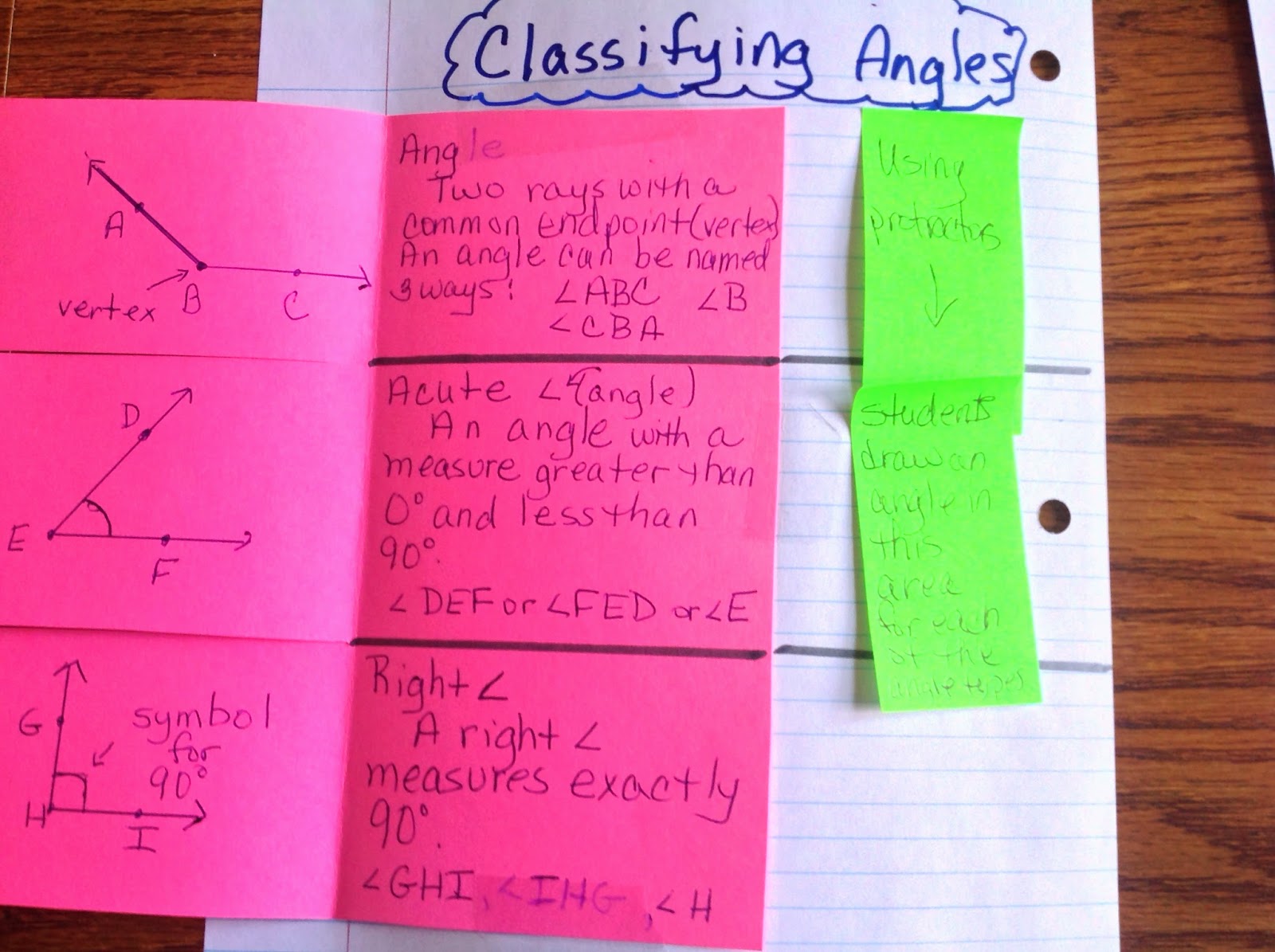

The students used protractors to draw their own angles where the green post it is.


     I love utilizing materials that I have. In hindsight I may arrange these horizontally next year so they all fit onto one page.

2. Measuring and Classifying Triangles
     We completed this foldable and practice sheet from 4mulaFun  for our INB's. It was a good review of triangles for the kids and they are getting so much better with the cutting and pasting  activities. I finally gave up on glue and have the students tape their foldables in their notebooks. They were a nightmare with the glue, it was everywhere and the tops would get clogged. I used glue sticks but they didn't last long at all. Tape is expensive so any ideas from my readers is appreciated.

3. Sum of the angles of a triangle.
     I didn't really need to review this topic for Pythagorean Theorem but my students background is lacking so as long as we were talking about triangles and angles, I added this in for them. I can't believe I never saw this activity before to show the sum of the angles of a triangle equal 180 degrees. It takes no preparation on the part of the teacher and I used paper from my scrap basket. YES! I had the kids take scraps of paper and draw an acute triangle, right triangle and obtuse triangle. The size or angle measures were up to the kids to decide. Then they colored or marked all the angles of the triangles. I then had them rip the angles and reassemble them to form a straight line. So easy and a great visual for them. It took a few tries to get the angles lined up so it is like a puzzle. They loved it.
Tear the triangles into three pieces. Then assemble to form a straight line.    
equationfreak@blogspot.com
A great visual for showing the sum of angles of a triangle.
     Yes, I know the top triangle isn't lined up in a straight line. Funny none of the kids caught that! Not to worry, I will fix it.

4. Creating a geometry star
     It was the day before spring break and nobody wanted to be at school. There was an assembly and the classes were shortened to 36 minutes and the kids were, you know, a bit excited. What to do? Since we were studying triangles we did this quick project. Most of the kids finished in the 36 minutes and they were busy the entire time, calm and happy. Isn't that the way it should be before break? Again, I like this because all that was needed was paper, pencil, ruler and colored pencils. Easy. And it gets better, it is free on teachers pay teacher from Virtually Montessori. After break I will post some of the pictures the students created.


5.  Square numbers and square roots.

     We are making flash cards to memorize perfect squares and square roots. You can go to kitzkitz  to make your own flashcards to print. We  will cut the flash cards and then put them into envelopes in our INB's. This idea is from Mrs. Hester's Classroom. I only had the kids do the perfect squares for this lesson. They learned this very early in the year but now I have them memorize the squares through 25. The envelope to make the pocket is from homeschoolshare. They have a fantastic collection of templates you can use that are free. They also have templates for foldables that you can type on and print up. Check them out, they are a great resource.


                Here is the link to the flash cards for perfect squares and square roots (make sure to download the document to see square roots as well.) The originals are large and good for a math center but they use seven pages of paper. When I printed the individual flash cards for the students, I printed 4 pages on one page. That way I only used two pieces of paper per student. I'm always trying to save paper when possible.


I gave the students  the smaller version of the flashcards and they fit in the pocket nicely. You could also have two pockets instead of just one.
     I hope there is something here that is new that you will be able to use. One thing I am noticing with Common Core is that everyone is teaching the same topic at the same time so there is so much available for us to use with the kids. It is amazing. I am finishing up my Pythagorean Theorem unit and hope to post it by the end of the week.

                                                                 Until next time,

                                                                         Jan 


Sunday, March 09, 2014

Pythagorean Theorem - Real Life Lessons

     I have been searching for some real life application lessons for Pythagorean Theorem unit. You know the lessons that students can relate to, not the ones where you have a ladder placed against a building. I have found a two lessons that I absolutely love.

     The first is  Mrs. Hester's Pythagorean Theorem map lesson and it is exactly what I have been looking for. How often do our students actually handle a map and measure it?  And she uses a map of the town the students live in. Now that is something they can relate to and understand. I am sure there is a lesson that could be developed using technology but that will be for a later post.
                                           
     Mrs. Hester has students find how much cable AT&T will need to install U-verse lines in the town the kids live in. Unfortunately there are not many straight roads in the town I teach in. UGH! No wonder I get lost in this subdivision when I decide to take the back roads as a short cut. I'm determined to find a spot in this town that has straight roads. Until then I may just use Mrs. Hester's map. I love this lesson!
       
      The second lesson is Tim's 3 act, TV space,  at Embrace the Drawing Board.

     In this lesson, Tim has an area below a shelf, between two speakers and on a stand that he wants to place a TV. Will the Samsung TV fit in this space? Tim has more pictures with measurements and discussion questions. This again is the real life experience problems I am looking  for my students to do. They can relate to the problem and who doesn't want a big screen TV? Thanks Tim for this awesome lesson.
     As I have said before, I don't think I am a very creative person but I don't have to be. There are so many wonderful lessons out in Blogland that I can pull for my students to use. I don't need to spend hours making them, I can adapt the lessons that others have so generously shared. If anyone has other Pythagorean Theorem lessons they know of, please share them. I would love to see more of these.
                                                             Til next time,

                                                                    Jan


Monday, February 24, 2014

Three acts by Dan Meyer (taco cart)

       I discovered math blogs for the first time last year when I was getting my masters and doing research online. I couldn't believe I didn't know all these resources were available. One of the first bloggers I found was Dan Meyer. How did I not know about him? If you are new to reading blogs or you lived under a rock like I did, I want to introduce you to Dan Meyer (watch his video) and his 3 act lessons. Watching Dan teach this lesson is exactly what I needed to see. Now I can model and practice this teaching strategy myself. I need to slow down my questioning, increase the wait time to give students time to process the information, and then have them share.
     The kids love these lessons and they are amazing. The lessons are broken into 3 parts. The first part is a short video that sets up a problem for students to think about and predict what they think will happen. The second act is giving some of the information that they will need to solve the problem. You give them this after some discussion in class. Then the third act is the reveal or answer. But really, watch his video because it is so much more than that. I am going to use Dan Meyer's three acts taco cart lesson for my Pythagorean Theorem unit.

Click here Dan Meyer's taco cart act one

    I can't wait to use this lesson with my 8th graders over the course of a few days.  I would love to hear from teachers that have used this lesson with their classes. Any tips or suggestions are welcome.
     This is a link to Dan Meyer's 3 act spreadsheet. You are not going to be able to stop watching them! Enjoy!
                                                       Til next time,
                                                               Jan

Saturday, February 22, 2014

Pyhthagorean Triples Interactive Notebook page

     Does anyone else collect and save the scraps of colored paper that are left over from making foldables or am I the only crazy person who does this?  This is my scrap basket. Yikes! Looks like it's time to take out scraps to use for our interactive notebook.

My scraps basket. I just can't bear to throw away all these colors.
      We are going to make freehand,  (I just show them how to cut the shape under the Elmo), matchbook foldables for our Pythagorean Triple page in our interactive notebooks. If you don't want to make freehand matchbooks there is an unbelievable site at Home School Share that has a Lapbook template section that is amazing. Check it out, you'll love it.
     So, the last time I tried to have the kids make a foldable freehand, we had some very interesting results. It reminded me of the Bill Cosby Himself  bit where he keeps telling the kids, "come here, come here, come here, no come here!" I kept saying, "cut here, cut here, no cut here not there! UGH! " Finally my students just started making their own shapes and they turned out great. Here are some pictures of the pages my students made. The examples are from when we were working on combining like terms.

These shapes were much easier than the hexagon I was having them cut.

These were adorable.

When you open the foldable there is a list of like and unlike terms in each one.

     The Pythagorean Triples foldables are going to have specific dimensions to make it easier for the kids to make them. First they will need to find the 4 different colored scrap pieces of paper. They will draw rectangles 5 in. by 2.5 in. This shouldn't be hard for them to do.

Then have them fold the matchbook almost in half. Leave a small lip for the tab at the bottom.

This is a copy of the INB page. They list three numbers on the outside of the matchbook.

And on the inside they show their work to check to see if the numbers are Pythagorean Triples.

These are the matchbooks with completed examples.


My next post will include another page for Pythagorean Triples made from scraps of paper for the left side of their notebooks..

Til next time,
Jan


Monday, February 17, 2014

Getting ready to teach Pythagorean Theorem (Part 1)

      After spring break I will be starting Pythagorean Theorem. I'm really excited about this unit because in the past I have had to teach it quickly and move on. I would spent 3 days max on it, but this year I am going to spend much more time and go into the material at a deeper level than I ever have before.

The learning targets that I need to cover are:

 Prove, model and explain Pythagorean Theorem.
 Use the Pythagorean Theorem to test a right triangle.
 Identify Pythagorean triplets
 Find unknown side lengths of right triangles.
 Use Pythagorean Theorem to find unknown lengths of right triangles to solve
volume and surface area problems.
 Use Pythagorean Theorem to find the length of slanted lines on the coordinate
plane.
     There is a lesson on Pinterest where kids use Cheez Its to model Pythagorean Theorem. I think I am going to use Starburst candies, (by Pam Lucken), instead for this lesson. Less crumbs and not as messy. Believe me when I say my eighth graders can make a huge mess in my room. I am sure some of the candies will mysteriously disappear so I need to see where I can buy a massive amounts of Starbursts. There are 150 students in my classes so I will need a lot of candy even with students working in groups.


       I've also seen this modeled with other manipulatives but candy is so much more fun! Don't you think?

      I've decided to get started on my Interactive Notebook now so it will be all ready go and I won't have to work on it over break. I will be posting my unit in bits and pieces as I finish them. I was looking for a foldable that was a little different than the ones that I have done with the kids already. I have not used a brochure foldable and I saw one similar to the one below and added some of my own problems.


            I usually spend one day on the types of problems on the left where the kids have to look at the sides and determine whether the sides form a right triangle. I'm still looking for activities to add to this section.

In their notebooks I will have them make a list of steps to follow. 


Click HERE to download the Pythagorean Theorem foldable.


Enjoy! Til next time,Jan


Related Posts Plugin for WordPress, Blogger...