Showing posts with label Kagan structures. Show all posts

Thursday, August 24, 2017

Exponent Interactive Notebook pages

Hi everyone. Well it is official, I actually retired in June. During the summer I didn't feel any different but with the school year beginning last week, it now feels real. I'm looking forward to taking a fall vacation, something I could never do when I was teaching. 

As much as I wanted to do lots of posts last year it was just too hectic. But now I have the time to clear out the over 60 posts I started that are sitting in my draft box. So I will be coming back from time to time to share them. I know the first unit we covered in 8th grade was exponents so here are a couple of interactive notebook pages I made last year. These were used in my 8th grade Pre-Algebra classes. Enjoy!


My students enjoy coloring so I used numbers that could be filled in. They loved it! 
(The arrow by the word base should be pointing to the 5, not  away from it,) 


Having the way you say these problems in written form was very
 helpful for my second language learners.


You could also cut the back page and make this a tri-fold foldable. My students needed help with the correct way to say each of these so I left the section with the verbal expressions showing. I know this seems elementary but my students always mixed up the last two types of problems. (Update... the bottom problem has been corrected on the download to (-2)^5.)
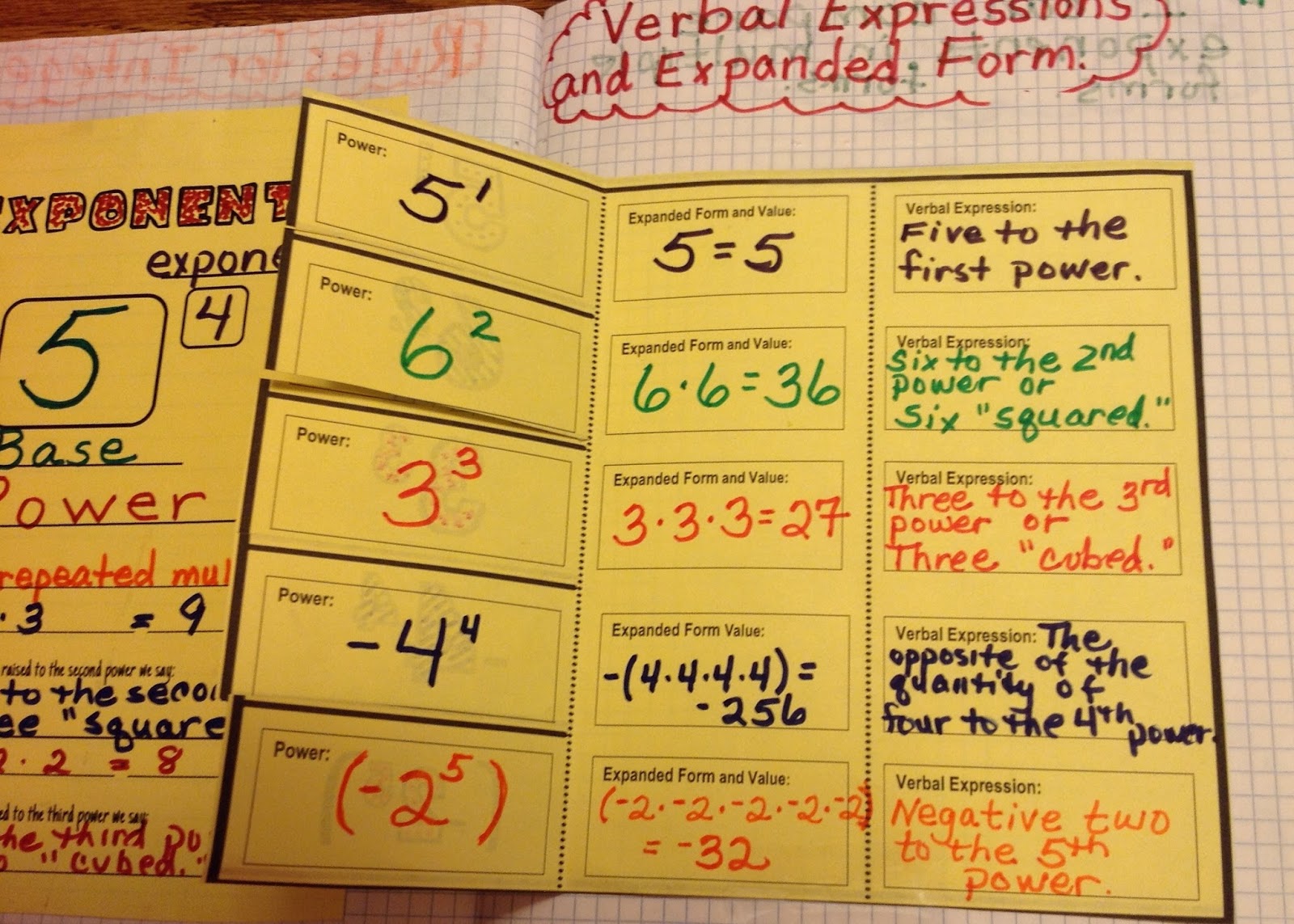

I like how this foldable turned out. 


Then the kids reviewed their exponent rules using a Kagan Structure called Rally Coach. I must admit Rally Coach is my favorite Kagan Structure and I used it all the time with my students. It really gets kids talking about math which helps their understanding so much. See my previous post about Rally Coach HERE.

Download files here:

Exponents - graphic organizer

Exponent foldable - Verbal and Written forms

Rally Coach Exponent Review Cards


Previous posts on exponents:

Exponents INB pages

A few more exponent pages - INB

Squares, Cubes and Fractional Exponents

Have an amazing school year everyone!


Til next time,

Jan


Sunday, February 05, 2017

Similar Figures Foldable, Matching Activity and a Rally Coach structure

      I made a goal to write a post everyday until the end of the school year. Well, that lasted for a total of one day. It amazes me that people can do that! I just can't find the time. Now my new more realistic goal is three times a week. They may be short posts or they might be all pictures but I will post them.  
     In 8th grade Pre-Algebra we finished studying Similarity. I'm pleased with how well my students are working on their interactive notebooks. Being able to cut, color, tape and assemble our foldables is such a wonderful sensory activity. It benefits so many of my students who are hands on learners and many of my ADHD kids.  Then there are my creative girls who come to class with big smiles and pencil cases full of colored pencils and markers ready to begin class. I provide colored pencils and markers for them but these girls love to add special touches with their supplies. On my foldables I've been adding area that they can color in if they like. This is great for those who can copy quickly as they can color while they wait a minute for some other students to finish copying. If you haven't tried using foldables as part of your instruction I strongly encourage you to try some. It will take the kids time to get use to cutting quickly but they get much better at this skill as the year goes on. Also adding some fast music in the background helps them to cut and work faster as well. I always put on Twist and Shout, they want rap but I tell them they have to listen to my music. They like it.
     Here is the foldable that we did on Similar Figures. I like how it turned out. Maybe a few more word problems but we had a work page of word problems that we put next to this foldable. I can't tell you where this work page is from. I've had it forever and love it.


   Next, we went over some vocabulary and some basic problems. I reviewed proportions with them as well as one step equations. 


Then we went discussed shapes that had to be rotated 
to find the corresponding sides.  
(Uh oh, I forgot to finish a problem. UGH!)

Coloring the corresponding sides helped many of my students 
who struggle with this concept.


   Then in groups the students did this matching activity that is free at teachers pay teachers by Mrs. Slick. They had fun with this activity. I had each group work with me at the table for a few minutes. I started with my lowest group so I knew that they understood what to do. Then I walked around and watched the fun.
    
       I was thrilled to find the resources in the link below from Utah Education Network. I used the Rally Coach activity on similar triangles from them. See previous post on how to use a rally coach structure in your classroom. Kagan Structures are different from how the Utah site explains it. I thought it would be easy for them, but as they did the activity it became obvious that my kids needed easier problems. I would go back and redo it for the kids I teach. There are lots of great resources at this site. Unfortunately, I didn't have time to use more of them.

Downloads and Links:

 Similar Figures foldable

Work page four word problems

Similar Figures - Rally Coach, Utah Education Network


Til next time, (Hopefully tomorrow.)

Jan

Sunday, July 26, 2015

Kagan Structures- Creating your groups (teams)

     Last year, as part of our school improvement plan, all the teachers in my building participated in three professional development days with a certified Kagan instructor. We will finish the last two training sessions on cooperative learning this coming school year. If you ever have the opportunity to go to a training do it. It's amazing and so much more than just cooperative learning groups. The entire training is hands on and you participate as a student would in your class. You can walk into your classroom the next day and use structures with the kids immediately. Go to Kagan online to get more information.

     The first thing I needed to do last year was to set up my groups. At the beginning of the year I started with random groups, which was fine for the first couple of weeks, but this year I am going to start immediately with heterogeneous groups. Our students take the MAP (Measures of Academic Progress) test three times during the year. I will have access to their spring MAP test scores from last year that will help me create the groups. You can use any test that you want, as the year went on I used pre-tests and formative and summative assessments as well.

     Kagan believes that groups of four students is optimal. Each group should have two boys and two girls. This isn't always possible so I do as many as I can and then make all boy or all girl teams. If there is an odd number of students in the class then there will be a group of five or sometimes two groups of three with the remaining groups having four students. I did vary this last year with a couple of students that were boys. They were non-stop off task students when with another boy so they were placed in groups of all girls. Those girls kept them in line and they definitely had better behavior to impress the ladies. (This was not a Kagan suggestion. Just something that worked for me.)

     To create my groups I needed my class rosters, the list with student MAP scores, a pile of index cards and colored pencils that match the colors of the groups.


  • On the top of the index card I placed the students name and their MAP math and reading score and if they were a second language learner. With my second language learners I place another student who speaks the same language if possible.
  • Next, I placed all of the index cards in order according to math MAP scores from highest to lowest. The I divided the index cards into 4 groups, HIGH, HIGH MEDIUM, LOW MEDIUM and LOW scores. 
  • Each group has one of each level student. Take a card from each of the groups of index cards and you have your teams.
  • On each index card I use a colored pencil to mark the team the students are placed in. In my classroom I have different colored stars above each of the teams, yellow, green, red, purple, pink, orange, blue and salmon. By placing the colors on the index cards I can make sure that when I change groups the students aren't place with the same peers again.
  • When placing the students in the groups you have them seated like this:                                                                    
                                      LOW MEDIUM           LOW
                                      HIGH                            HIGH MEDIUM
  •  The high student next to the low medium can help that student when they work as shoulder partners and the high medium can help the low student in their understanding. Also having students with similar levels across from each other helps them to feel comfortable with students who are closer to their levels when working as face partners. I always had these students sitting next to each other but staggered the arrangements in the groups so they couldn't figure out who was the low or high one in each team. Groups should be changed about every six weeks.
     There are desks not tables in my room which works out very well. When they take assessments I have them move to rows. We practice this the first week of school. I also noticed when I lecture they didn't pay attention so now when I lecture I have them facing forward and not in groups. (I don't lecture too much but when I do this seems to work for my kids.) It will be interesting having students this year who know the Kagan structures and expectations. I can't wait to see how much better there participation and understanding is.
   
     On a side note, one of the claims of Kagan is that their structures improve learning for all students because of the level of engagement involved. Last year my school had the highest gains of all eight middle schools in the district on MAP scores. Now I am here to tell you my school is always right in the middle. We have a 65% poverty rate with the majority of our students who are second language learners (which several of the other schools do not), and we never have the highest gains. The only thing we did differently was this training and all the teachers used these structures in their classrooms. Hmmmm... very interesting. 


To buy this book go to :
 Kagan Cooperative Learning on Kagan website
or Kagan Cooperative learning on Amazon.

  Chapter 7 of Kagan Cooperative Learning goes into great detail as to how form groups. 

 Disclaimer: I am not a certified Kagan instructor. All of the information given are my thoughts and reflections of the training I attended.

Til next time,
Jan


Saturday, January 24, 2015

Rally Coach (Kagan Structure) with word problems

This morning I woke up and decided to sit, drink my coffee and catch up on reading some of my favorite blogs. Justin at Re-Learning to Teach had a post where he reflects on some of the very same issues I have with many of my 8th grade Pre-Algebra students. I started to leave him a comment but it was very long so instead I have decided to join Justin's "Whine and Cheese" party here on my blog. 

Most of my posts usually involve lessons I am using in my classroom or reflections on training I have completed. However, I have failed to reflect on the behaviors of many of my students and strategies I may take to improve their behavior. Many of my 8th grade Pre-Algebra students are exactly like Justin's students. The majority of my students do not complete homework when it is assigned and are not getting the practice they need to learn the skills that are being taught. We have been working on writing equations from word problems which is difficult for many of my students especially my second language learners. We used my most used graphic organizer, (see previous post HERE), and I decided to use a Rally Coach Kagan Structure in class to give them the practice they needed in a fun way.

I am fortunate that my school has been receiving Kagan training throughout the year as part of our School Improvement Plan. So far this year we have had three full day training sessions. The entire school has been using these structures with our classes and it has been a great experience. 

If you are not familiar with the Rally Coach Structure I will try my best to explain it to you. First of all, the students in our classrooms are in groups of four, sometimes a group of three if there is an odd number of students. They have shoulder partners and face partners for group work. See this post on Kagan Structures for an explanation of the group set-up.

For the Rally Coach, students work with their shoulder partners. The explanation given from the teacher is important because social and group expectations are a huge part of Kagan. First, you explain what you want the students to do and the behavioral expectations for the group. Next, you let the kids know what behaviors you don't want to see and lastly model the expected behaviors. 

Here is what a Rally Coach looks like:

  • One of the partners is given a question that has only one correct answer. That's easy to do in math. 
  • There is also only one piece of paper and one pencil for the pair. 
  • Partner A solves the problem explaining their reasoning to Partner B. 
  • Partner B coaches Partner A if they need help and also affirms the work they are doing correctly. 
  • If the answer is not correct, Partner B coaches Partner A to arrive at the correct answer. 
  • Once they agree on the answer, the teacher checks it, and gives positive affirmations to the students or suggestions on what to change.
  • When the pair has the correct answer the teacher hands a new problem to Partner B. 
  • The students switch roles and repeat the process.
That was a very very short explanation of what we learned in one of our sessions.


 I knew the majority of the kids wouldn't do the homework so I took the homework questions and placed each question on different sheets of colored paper. I needed to have 16 copies of each question, one for each of the pairs in my room. The pairs were given only one whiteboard and marker and the partner who was doing the problem was the only one who could write on the whiteboard. When the students agreed on the answer they raised the whiteboard in the air, I quickly checked it and handed the next question to that pair. The different colored paper made it easy for me to keep track of what question I should give them next. I had a total of 10 questions and only a couple of pairs were able to answer all of the question in a 45 minute period. 

I am here to tell you I was amazed at how the kids behaved and stayed on task. All but one of my 100 Pre-Algebra students were actively involved. The one student just drew basketball courts when it was his turn. Another day, another story. Best of all, they all had the practice that I wanted them to have and they didn't have homework. Everyone was happy:)

I really like how we teach social skills along with the math that we do. I have seen an improvement in how the kids are reacting to each other in class. They are learning how to interact with each other in a positive way, how to give and receive affirmations and are learning a little more patience.

It was a fast paced period, good thing I wore my gym shoes that day. I will definitely use this strategy again. Let me know if you try this and how it works. 

Til next time,
Jan


Sunday, August 24, 2014

Kagan Structures

     I am so excited! Two weeks ago, my school finished its first all day training on how to use Kagan Structures in our classrooms. The entire school is participating in three training sessions throughout year. I have been teaching for a long time and didn't ever think there would be any training I could receive that would improve my students behavior during group work. Well, I was so wrong. When Kagan instructors say, "It's all about engagement," they are so right. In the past when my classes have worked in groups there were always those students who just did nothing, while others would just hide from me. Some students would work hard and others would be talking and off task. It was hard to keep them all engaged. So here are a few things that I learned and started using with my classes this week.
    The first thing I needed to change was how to get my classes to be quiet and listen. I have always used the 3-2-1 countdown, given them the stare or said, "Shhh, shhh, shhh." I became very frustrated that I had to waste so much time on this. Our trainer said that simply saying, "Signal Please,"  then raise your hand and have all the students raise there hand and look at you. You say nothing else, just sit and wait. When everyone is quiet and looking at you say, "thank you," and then continue with what you want to say. Now this seemed very elementary to me but I saw it work with the 50 middle school teachers in my building during our training. Now if you can get middle school teachers to stop talking that is quite a feat! I started using the quiet signal this week with my students from day one. These were actually the first words out of my mouth in all of my classes. I am here to tell you that I am shocked that it is taking less than 5 seconds to get everyone looking at me and quiet. We also had our first assembly Friday and the teacher leading the assembly used this quiet signal and over 700 students became quiet and attentive. All of our teachers are using this quiet signal so the kiddos know exactly what to do. So simple, how come I didn't know to do this years ago?
     The next thing I changed was how my classroom was arranged. All of the tables or desks are now in groups of four and at an angle so that everyone can see the teacher without turning around. In the center of each of the tables are Kagan mats.Click here to see Kagan Mats from the Kagan catalog. I am still in the process of placing the finishing touches on my room. Pictures of my classroom will be posted later this week. (Our open house is Thursday so you know it will be finished by then!) A teacher at my school made mats that are similar and I cut them into four parts placing one on each desk. Unfortunately, my desks do not make a flat surface so the mat won't stay put. Cutting the sections apart and securing them with packing tape should work for awhile.
     The next step was to keep the kids engaged and accountable for their learning. Every ten minutes you need to change your engagement to keep their attention. The first day consisted of getting to know you activities. The next day the problems were math based. I wanted the kids to understand that there are many ways to solve a problem and that some problems can have multiple answers. I guess the easiest way to explain this is to give you an example of some of the problems we did in class last week. 
   

     Warm up #1

Which number does not belong and why:
36     81     9     25     72


Teacher: I am going to give you 1 minute of quiet think time to find the number in the list that does not belong. Write the number you found with an explanation of why it does not belong with the other 4 numbers.

     I put on my timer, click here for an Online stopwatch, and let them work. After the timer went off I said this:

     Teacher: You will be working with your shoulder partner and explaining what number you chose and why that number does not belong with the others. If your partner has a different number than you write down their number they along with their reason. You will have one minute  to share. Partner A will start and Partner B will listen. Ready, go.

   It is important to give the instructions first and save who is going to begin til last. That way everyone is listening to the directions. I put the timer on and walked around the room while students shared. Then we did the same thing with partner B explaining the number they wrote down. Next, we shared as a group with the student 1 (look at the mats) explaining what their partner had and going around the table. The group created a group list that we shared as a class when they were finished. I gave them 3 minutes to do this.
    As you can see, everything is timed, and anywhere from 25% to 50% of the students are talking and explaining during the activity. Instead of me explaining everything, the students are explaining and learning from each other. There are no more students hiding and not participating. The activities we started with this week have no right or wrong answers so I am creating an environment where they feel safe sharing with each other. ( I of course thought that 72 didn't belong because it was not a square number. Other possibilities, 9 is the only single digit number, 25 is not divisible by 3 or 9, and 25 because the sum is not = to 9.) Any other answers that you see?


                                                   Warm up #2

                                         How many squares do you see?


     This was a puzzle I found on Facebook a couple of years ago. The kids love this one and there is a short video that shows the best answer for this problem. Again, I stressed that the question is, "how many squares so YOU see?" There are many different answers, none are wrong, but one answer that is the highest number of squares. Click here for a video that shows the best answer for How many squares?


                                                  Warm up #3
        Find a word worth $0.60 when A=$0.01, B=$0.02, C=$0.03,etc.


     The last problem that the kids work on last week was the = 0.60 cents problem. It was so much fun watching the groups work to try to find a word that would = a sum of 0.60 cents. Watching the kids, I realized that I need to work on problem solving strategies with them. I thought the very first thing the groups would do was to make a list of the alphabet with the corresponding numerical value next to each letter. They didn't! Most of them were counting through the alphabet for every single letter. Using the guess and check strategy most groups did come up with a word. They loved this problem and my Algebra classes wanted more time to work on it the next day.
     One of my students was excited because he found that the word, yes, added to make 60 cents. However, he had the letter s as being worth 20 points when it should have been 19. When I looked at his list of the alphabet the letters were in this order; m, n, o, p, q, U, r, s, t .... At first I laughed to myself and explained to the student that q is followed by u in words but not in the alphabet. I was also sad because it reminded me of how much background knowledge I think my second language students have but may be missing.
     The structures I have used so far are the rally robin, round robin and stand up-touch down. I am also using random grouping until I have some test scores for my classes. I will explain how to create groups and what these structures look like in a later post. I need to go through it on my own first. 

Til next time,
Jan
     

 Disclaimer: I am not a certified Kagan instructor. All of the information given are my thoughts and reflections of the training I attended, as well as activities that I decided to implement.

Monday, July 21, 2014

Changes, Changes, Changes, Brain Dump number 1

                                        
                                                                               blog.esker.com

      I have to admit it. This year I feel terribly overwhelmed with all the changes that we are expected to make, I don't even know where to start. So when I feel like this I have to do a, "brain dump." I just take everything that is floating around in my head and dump it onto paper. Once I do that I feel like I can get an idea of where to start or at least do something from each category. So here I go.
    1. My first priority is to make lessons that align to Common Core Standards.  I began with my 8th grade Pre-Algebra classes last year but did not change anything with my Algebra. Second semester is when I started feeling good about the changes I made to the Pre-Algebra curriculum, but my 1st semester lessons are not put together the way I would like them to be. I can not go into the school year, less than one month away, without having the first units ready to go. I have bits and pieces but I'm not there yet. Twenty-four days til school begins. Yikes!
     Algebra is another story. I have always used the Algebra book and then supplemented where needed. Now, not having a book to refer to is really a challenge for me. In Pre-Algebra, I haven't used the book in years, but the Algebra book has been great. Not any more! The curriculum is all over the place in the book as I am sure you all know. On the last day of school we were given the curriculum and told we could pull from the book or use Engage New York - Algebra and follow it day by day. I guess I am going to try Engage New York and fit it to the needs of my students. Looking at the first module is a challenge. I like to have a book to see how everything is laid out. This is so big that to print it all is ridiculous so reading it on the computer is what I am going to have to do. We will see how it works.
     2. Standards based grading and Common Assessments- My district did provide training on SBG this summer. See my post on SBG here. I've been reading blogs and I did go through the training but I am still having a hard time with writing assessments for this. 
    3. Interactive Notebooks. I want to use Interactive Notebooks with not only my Pre-Algebra classes, but also my Algebra classes. This is going to be a lot to do considering curriculum changes this year.Why not do everything at once? I may do a modified INB scattered with more traditional notes. We'll see. Last year was my first year using INB's with my Pre-Algebra classes. I want to improve on what I started last year. See my post on Reflecting on my first year using Interactive Notebooks . 
     4. Kagan strategies - My building is going to receive training from a Kagan instructor, four times this year. (See Kagan strategies) I know just a little about these methods but am excited to learn more. I am going to pick up a book from our library on this and do some pre-reading before the training so I have a better idea what this looks like. I will be implementing these strategies in all my classes but as far as getting everything organized before school starts in this area is going to be difficult. 
     5. Group work- The layout of my classroom is going to be different this year. I have always had rows in my room as another teacher comes in for two periods a day. This will be a new teacher this year so I am going to have groups of four around the room. The newbie will think it has always been that way. Yeah! Kagan strategies are going to be used to help with the group work. I'd better get reading soon to get a head start for the year.
     6. Technology and Geometer's Sketchpad - How do I add more technology to my classroom? I have a smartboard and am comfortable with that. I use graphing calculators once in awhile, they are 25 years old and I spend so much time fixing them. I plan on using Geometer's Sketchpad when we hit graphing in both Pre-Algebra and Algebra. Geometer's Sketchpad is going to be an amazing tool to use with transformations in Pre-Algebra. I can't wait to use it for that unit. If I can do that much this year with all the other changes I will be making I think that is a good start. (See my post on Geometer's Sketchpad .)
     7. PARCC testing. This will be our first year using PARCC assessments. My students need exposure to lessons and assessments that will prepare them for the types of questions they will see.
     8. Writing standards. In my INB's (Interactive Notebooks) I am going to have the students journal more. As part of my SBG I will have questions that are more like the extended response problems I have used in the past. These problems have the students writing out explanations and I will use our writing rubric to grade the students work. 
     9. Pre Tests. I don't always pre assess prior to starting a unit. As a department we have created pre assessments for the vocabulary for each of our units. It is a starting point in this process.
    10. Differentiation. This is the hardest thing for me to do. Last year Pre-Algebra classes had students that were in the 1st through 76th percentile on the MAP test. This wide range made it so hard to differentiate. I am going to work hard to do better in this area. One of the ways I plan to do this is in the group work. I've never used stations in my class but I'm going to give it a try this year.
     Wow, I knew there were changes this year but oh my goodness! I didn't think it was this much. No wonder I'm stressed. Thanks for reading my ramblings. I'll keep you posted on my progress attacking my new to do list.
                                                            Til next time,
                                                                   Jan

    
Related Posts Plugin for WordPress, Blogger...