Showing posts with label foldables. Show all posts

Thursday, August 24, 2017

Exponent Interactive Notebook pages

Hi everyone. Well it is official, I actually retired in June. During the summer I didn't feel any different but with the school year beginning last week, it now feels real. I'm looking forward to taking a fall vacation, something I could never do when I was teaching. 

As much as I wanted to do lots of posts last year it was just too hectic. But now I have the time to clear out the over 60 posts I started that are sitting in my draft box. So I will be coming back from time to time to share them. I know the first unit we covered in 8th grade was exponents so here are a couple of interactive notebook pages I made last year. These were used in my 8th grade Pre-Algebra classes. Enjoy!


My students enjoy coloring so I used numbers that could be filled in. They loved it! 
(The arrow by the word base should be pointing to the 5, not  away from it,) 


Having the way you say these problems in written form was very
 helpful for my second language learners.


You could also cut the back page and make this a tri-fold foldable. My students needed help with the correct way to say each of these so I left the section with the verbal expressions showing. I know this seems elementary but my students always mixed up the last two types of problems. (Update... the bottom problem has been corrected on the download to (-2)^5.)
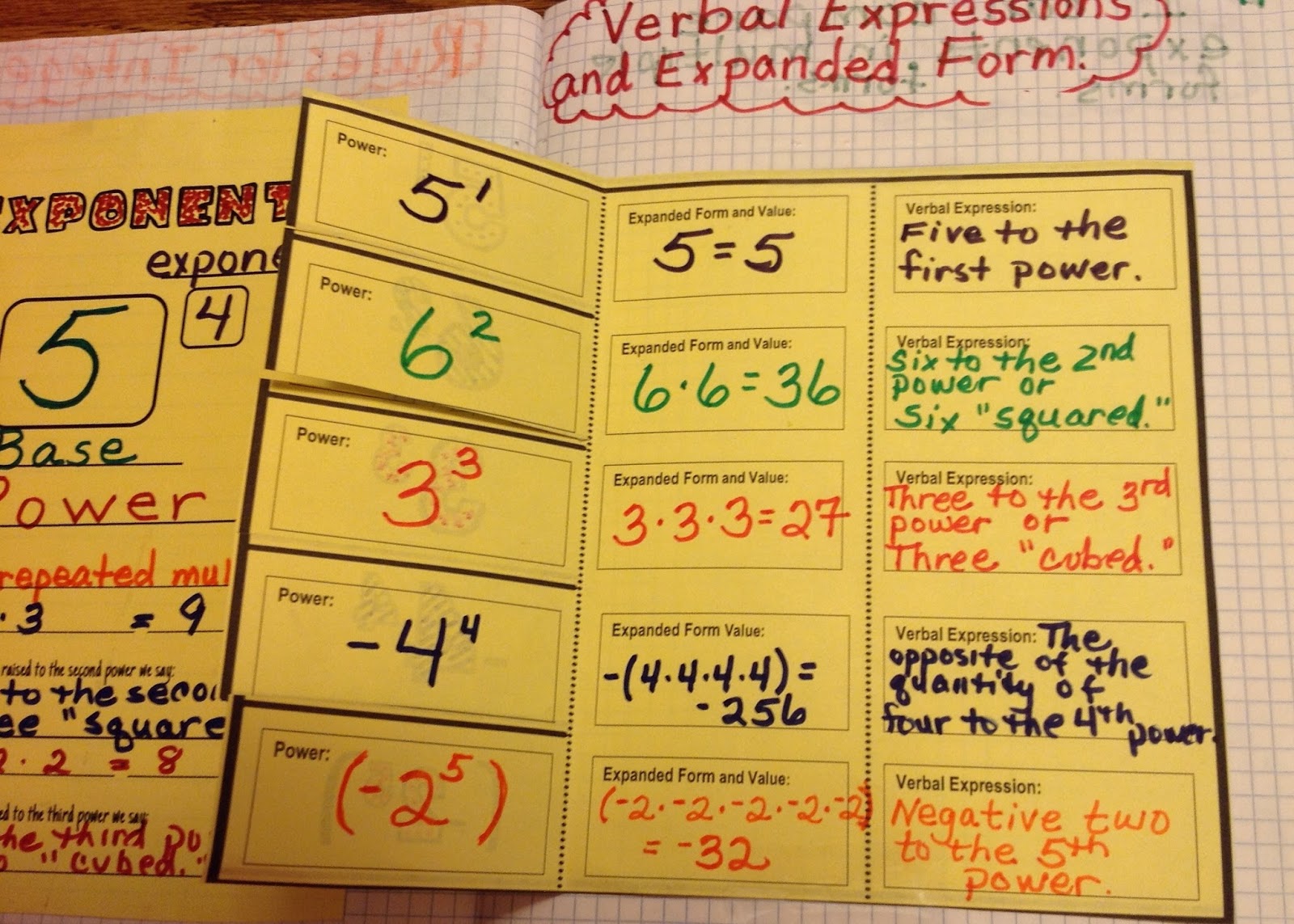

I like how this foldable turned out. 


Then the kids reviewed their exponent rules using a Kagan Structure called Rally Coach. I must admit Rally Coach is my favorite Kagan Structure and I used it all the time with my students. It really gets kids talking about math which helps their understanding so much. See my previous post about Rally Coach HERE.

Download files here:

Exponents - graphic organizer

Exponent foldable - Verbal and Written forms

Rally Coach Exponent Review Cards


Previous posts on exponents:

Exponents INB pages

A few more exponent pages - INB

Squares, Cubes and Fractional Exponents

Have an amazing school year everyone!


Til next time,

Jan


Tuesday, February 07, 2017

Combining Like Terms and Distributive Property Interactive Notebook Pages

   
     Last week, in my Pre-Algebra classes we learned about like and unlike terms. We completed this foldable from Sarah at everybody is a genius  on combining like terms. All of the foldables on this page require no prep work. The students do all the cutting, writing and folding.


     These are pages I have used with my students in the past. I spruced them up a bit to look better. I like how this page turned out. These are matchbook foldables and I love them because they are small and we use up lots of my leftover bits of paper.


We completed the foldable below from Sarah at everybody is a genius  combining like terms. I like how Sarah has the students place lines before all of the + and - signs to separate the terms. This is such a great visual for my students and really helps my struggling students. 


Then we did a work page for the other side of our interactive notebooks. I did this as a guided practice with them. The problems are all a little different so there was lots of review for them over integer rules and like and unlike terms. We places the lines in front of all the + and - signs like in the foldable. They understood it!


The next day we learned about the distributive property. We wrote a Frayer Model vocabulary model, did several problems together practicing the steps. On the third day we completed our distributive property foldable where we added combining like terms. Love this page:)


I'm sure you can come up with a better Frayer Model than this.
 I think I could improve the definition and facts.


This page was great. My students always get so mad at me because I MAKE them write down the distributive property the long way and not just using arrows. I find it helps them to make less mistakes on signs when they write it all out. 


I saw a foldable like this somewhere and I never made one like this before. Of course, I had to make it. It took awhile but finally everything lined up and it turned out great.
The problems increase in difficulty as you go and the kids did a great job on this. I'm doing the happy dance because they never can understand the types of problems on the bottom and this year they did!


Hope your are enjoying my last semester journey with me. 
70 days to go til retirement.

Download files here:

Go to my teachers pay teachers store for 


 Til next time,
Jan


Sunday, September 04, 2016

Divisibility Rules for 2,3,4,5,6,8,9,and 10

Divisibility rules are not a topic that I normally cover but the students in my 8th grade Pre-Algebra classes needed this review so I made this foldable for our notebooks. 

When I teach this I always group the rules together that are similar. It just seems easier to remember four similar rules than eight different rules. I wanted my foldable to group them together in the order I teach them. I debated about having 12 paired with 6 but I decided to place it on my second foldable along with the rules for 7 and 11 which will be my next post.


For the numbers 2, 5 and 10 they are looking at the last digit so those are the numbers in the first flap. Yes, believe it or not, we had to write that an even number ends in 0, 2, 4, 6, or 8.

Then the numbers 3 and 9 are the sums of the digits so they are on the next flap.

It bothers me that 6 is alone by itself. I still want 12 and 15 there but OK, I will get over it.

And lastly, a number divisible by 4 or 8 is to divide into the last 2 or 3 digits.They are on the last flap.


I used different colors for each different number and next time will draw a line separating the rules. There wasn't room for full sentences so I abbreviated quite a bit on this foldable. I told the kids they would need to write full sentences on an assessment and they groaned. Imagine that.


 Six is still alone. UGH!

The divisibility rule for 8 isn't used that often. We discussed how we would use the rule when it was obvious and that they could always divide by two and then four. Wait that could be paired with six as well. What!


I hope that grouping the rules together will help the kids remember them better. We shall see.

You can download this foldable HereWhen printing this file select landscape view.

This was a short post but I wanted to get this out tonight. Enjoy!

Til next time,

Jan


Saturday, August 13, 2016

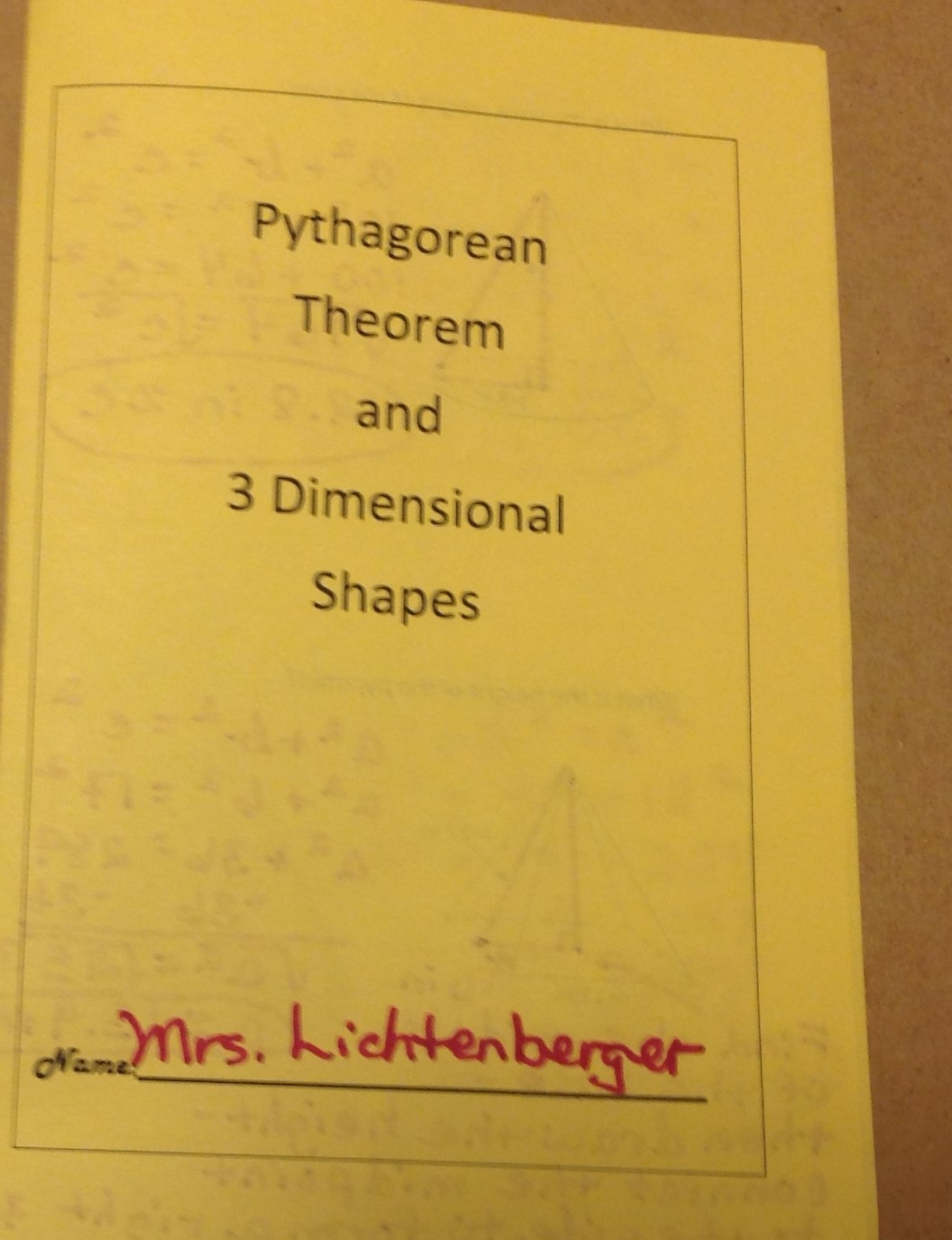
8.G.B.7 Pythagorean Theorem and 3 dimensional shapes

I'm back!! After a very difficult year I finally have the energy to blog. Have you ever had one of those years? It took me all summer to regenerate but I am ready to begin a new school year. The students start school Wednesday and I am already busy with meetings, so my mind is whirling with ideas. I can't wait to begin my 4th year using interactive notebooks. A post is coming up next week on this topic.

Now I need to finish sharing from last year! Everyone must think that the only thing I teach is Pythagorean Theorem. There are so many posts on this one topic. However, I really didn't have any materials that went in to the detail expected of this Common Core standard. Plus there had to be foldables, right? So here they are.


Standard 8.G.B.7: Apply the Pythagorean Theorem to determine unknown side lengths in right triangles in real-world and mathematical problems in two and three dimensions.


WOW, was it hard to find problems on this standard for the 3-D  shapes. After searching and searching and searching some more, I made these foldables for Pythagorean Theorem and 3 dimensional shapes.


My students needed help on how to draw the right triangle when the legs were not given in the problem. Once we had the drawing completed there was no problem. 


This next section was hard to find material at the 8th grade level as well.  


We only solved these using Pythagorean Theorem as that is the standard addressed here. 
Again, my students needed help on how to draw the two triangles when only one diagonal is given in the illustration. We traced the diagonal then the height of the vertical triangle, then connected the two points. Then we drew the triangle in the base.


I was concerned how my collab (A class with a mixture of special education  and general education) students would do with this topic. They understood it much better than I expected!!! Yes!!! 


I wanted a page with vocabulary as well so they understood that the diagonals were crossing the center of the rectangular prism. This page was perfect for that.

Teaching the Geometry in Pre Algebra is so much fun. I love it and the kids do as well. 

See you soon with a  post on how I start my interactive notebooks. Have a great new school year.

Below are the links to download these foldables:
I have some worksheets and exit slips I will add to this next week. They are in my school drive so I don't have access to them until Tuesday. So come back after that for more downloads.


Pythagorean Theorem and space diagonals

                                                                   Til next time,

Jan


l

Monday, February 15, 2016

Algebra -Dimensional Analysis Foldable

     My algebra students always have difficulty solving dimensional analysis problems. We needed to practice a little more and have some step by step instructions so I created this dimensional analysis foldable. I liked my scientific notation foldable from a previous post so much that I used the exact same template. Why not? 


I really like this foldable template :) The only thing that would have made it better was if it were in color.


       The students who had difficulty reducing the numbers could use their calculator. I am always surprised that my students haven't learned to reduce before they multiply when working with fractions. Really?


I think next year I may add a couple more word problems.


      I was telling my daughter, who is a high school biology teacher, about how the kids were having difficulty with this topic and she shared a fun worksheet that the physics teachers at her school created. David Thorpe over at Nerd Island Studios has given me permission to share this as a Word Document and said, " I am totally OK with it becoming public so that people can modify it to their own needs without attribution." Thanks David! So have fun with this sheet.  Check out the guys website. They have lots of simulations, IPAD apps, and a quizevolved site where the computer generates the same type of problems with different numbers. Awesome.
     My kids loved it and it was a fun way to have them begin to practice dimensional analysis.
 I changed the name of the Island to our school name and the King to King Smithoni as our principal is Mr. Smith. They got a kick out of that.


Click here to see and download the entire document: 

 Conantuki Island - Dimensional Analysis worksheet

      This post is mostly pictures as I am trying to clear out my draft box in my blog. It is sad when you have more drafts then posts. So enjoy the pictures.


Til next time,
 Jan

Sunday, November 01, 2015

Multiplication and Division of Scientific Notation Foldable

      Hi everyone, I'm back! I have never been away from my blog for this long and I've missed writing so much. My last post was on August 20th and I try to write at least every other week which obviously hasn't been happening. The reason I've been gone is because I have a new prep which includes a new computer program that I needed to learn. Well, I finally feel like I am getting a handle on everything so I now have a little time to blog. There are 57 posts in my drafts box and I have so much to share:) 
    My 8th grade Pre-Algebra classes are on an endless journey to learn everything they ever wanted to know about exponents. Right now we are learning how to solve multiplication and division problems written in Scientific Notation. I didn't have any luck finding foldables on this topic so I made my own. (I always like mine best anyway.) Here is the foldable I created for our Interactive Notebooks. 


This was actually put together at midnight the day before I taught this lesson so the left side could be changed next year. I do tend to procrastinate sometimes.


The foldable turned out to be the perfect size for our composition notebooks. Love it!


Don't let the division tab confuse you. It is the tab for the next section even though multiplication problems are written on this page. You can always cut it off because there is another division tab underneath. I became frustrated trying to get everything to line up so I just left the tab.


Sorry, there's a grammatical error here. It should say only the numbers are divided. 

Overall, I like how the foldable turned out. Hope you do too.

Click here to download the foldable:
Multiplying and Dividing with Scientific Notation Foldable


And I'll leave you with a link to Colin Dodds Scientific Notation Video. My kids absolutely love Colin Dodds. Enjoy.


Til next time,
Which will be soon I promise,
Jan

Tuesday, June 09, 2015

HOY and VUX foldable - updated

I'm cleaning out the drafts that I started so disregard the statement that I am still in school. You will see lots of posts like this in the next few days. 

So much to do and so little time. It is nearing the end of the school year and I'm crazed!!!! This picture sums up how I feel right now. Our middle daughter is a first year high school science teacher and she asked me, " Mom is the end of the year always like this? I am so stressed and can't get everything done." I answered, "Yes sweetheart it is. Then June will come, you will sleep for one month and wake up in July and feel normal again."

(This has been on Facebook and I'm sure you've seen it. 
I searched for the originator of this picture with no success.
I have no idea who created this so I can't give credit. ) 

So to save my sanity, I am going to post lots of odds and ends over the next few days. I literally have 50 drafts of bits and pieces of posts waiting to be finished. It's time to clean out that draft folder and start sharing. So here is the first one. 

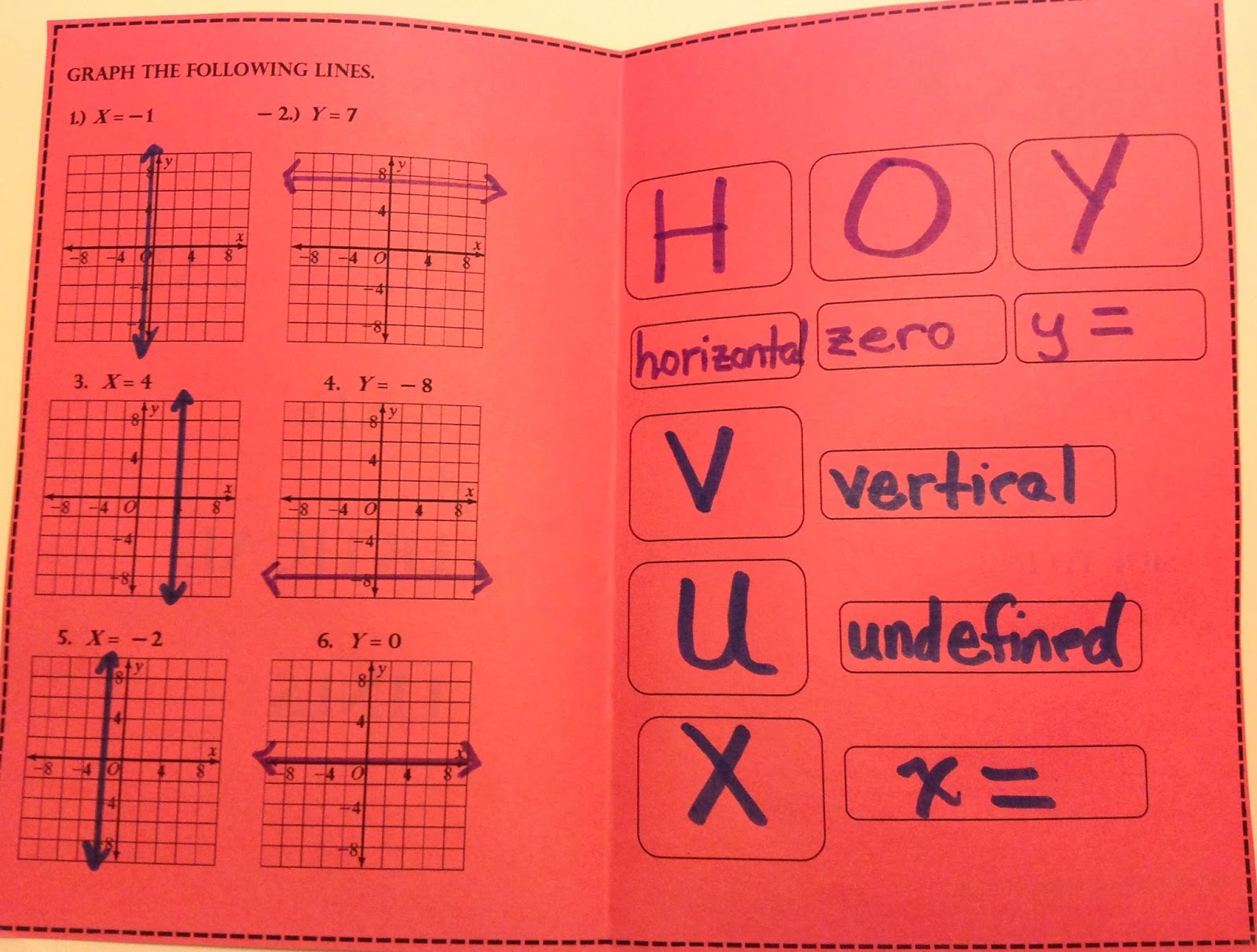
One of my first posts on this blog was my HOY and VUX graphic organizer. See original post HEREThis is an updated version made into a foldable. I think I like this one more.


      Click here to download the HOY and VUX Foldable.

I still have the HOY written horizontally and the VUX written vertically which is one aspect of the original that I really thought was helpful for the kids.


Hope you enjoy the updated version.
Til next time,
Jan


Thursday, March 26, 2015

Does the upside down division method work for everything - just about :)

    The upside down division method can be used to teach just about everything. OK, I exaggerated a little, but I use it to teach kids prime factorization, simplifying algebraic fractions, greatest common factor, least common multiple, and factoring polynomials. Teaching students one way to solve so many different types of problems makes it much easier for them to remember. I am sure that most of you are already very familiar with upside down division. If you are not, it is the cake method many people use for prime factorization, but upside down. See Sarah's post to explain the birthday cake method. The only problem I have with the cake method is if I don't start in just the right place the problem goes off the paper.This is not an issue with upside down division, you can keep dividing all the way down to the bottom of the paper.

    Initially, I teach this when finding prime factorization of numbers. Here is a foldable for their interactive notebooks. I needed to review divisibility rules with my kids before this lesson. 


I love prime factorization because it helps the kids review their multiplication tables with smaller numbers. They should know them but so many of my kids don't.  :(


 I like how this method doesn't take up as much space as the factor trees do.


I have started making more of my notes fill in the blanks. It saves so much time. However, I don't like to have them all written for them.


   I do a quick review of short division with the kids. Many of them have never seen this before.

     We use this method again when simplifying algebraic fractions.


 Here's a foldable we used for simplifying fractions.


I usually draw a fraction bar between the numbers. I forgot to do that on this foldable.


    Before we do upside down division with fractions, we have written fractions in expanded form and simplified to find the answer. They are familar with the exponent rules already.


     Next I use this with Greatest Common Factor and Least Common Multiple. 


I originally had this foldable as one foldable, but I decided to cut it in half and have a separate page for GCF and LCM. The students have already learned the other two methods for finding GCF. They have also covered exponent rules 
as well.


Instead of circling the common factors, the students place a large G over the numbers. It is an added visual for the kids.


Upside Down Division for LCM is also called the Ladder Method. I never knew that until I started writing this post. You learn something everyday:)


On LCM the students draw a large L around the numbers as an added visual.


     Lastly, we factor polynomials using Upside Down Division. 


My Pre-Algebra students always have difficulty with this topic. Using the Upside Down Division makes it so much easier for them to understand.

     
Download documents from this post here:

I am so happy to have all of this written and saved in one place. I litterally had to search everywhere to consolidate all the pieces. I hope there is something new for you to use.

Til next time,
Jan :D
Related Posts Plugin for WordPress, Blogger...