Showing posts with label summative assessment. Show all posts

Saturday, December 19, 2015

My favorite project -- year 2

     This is my second year using my transformation project as an assessment and I love it! See my previous post here, transformation summative assessment, for all the details. The timing of this project couldn't be any more perfect as it falls the week before winter break. My kids were so busy and engaged while they worked on this. I had music playing and we all had a great time. 
     The key to this assessment is that it never leaves the room. I've debated long and hard about whether to post the students pictures because students could google and find this to copy. (Just to let you know, there are errors in all of these pictures.) I would love to hear your opinions about whether to post student work or not. As I said, the way I get around the copying is that this never leaves the room and they have to work on it while I am present. Even if they get ideas from other places, they still have to do all the work. With that said, here are some of my favorites from this year. 
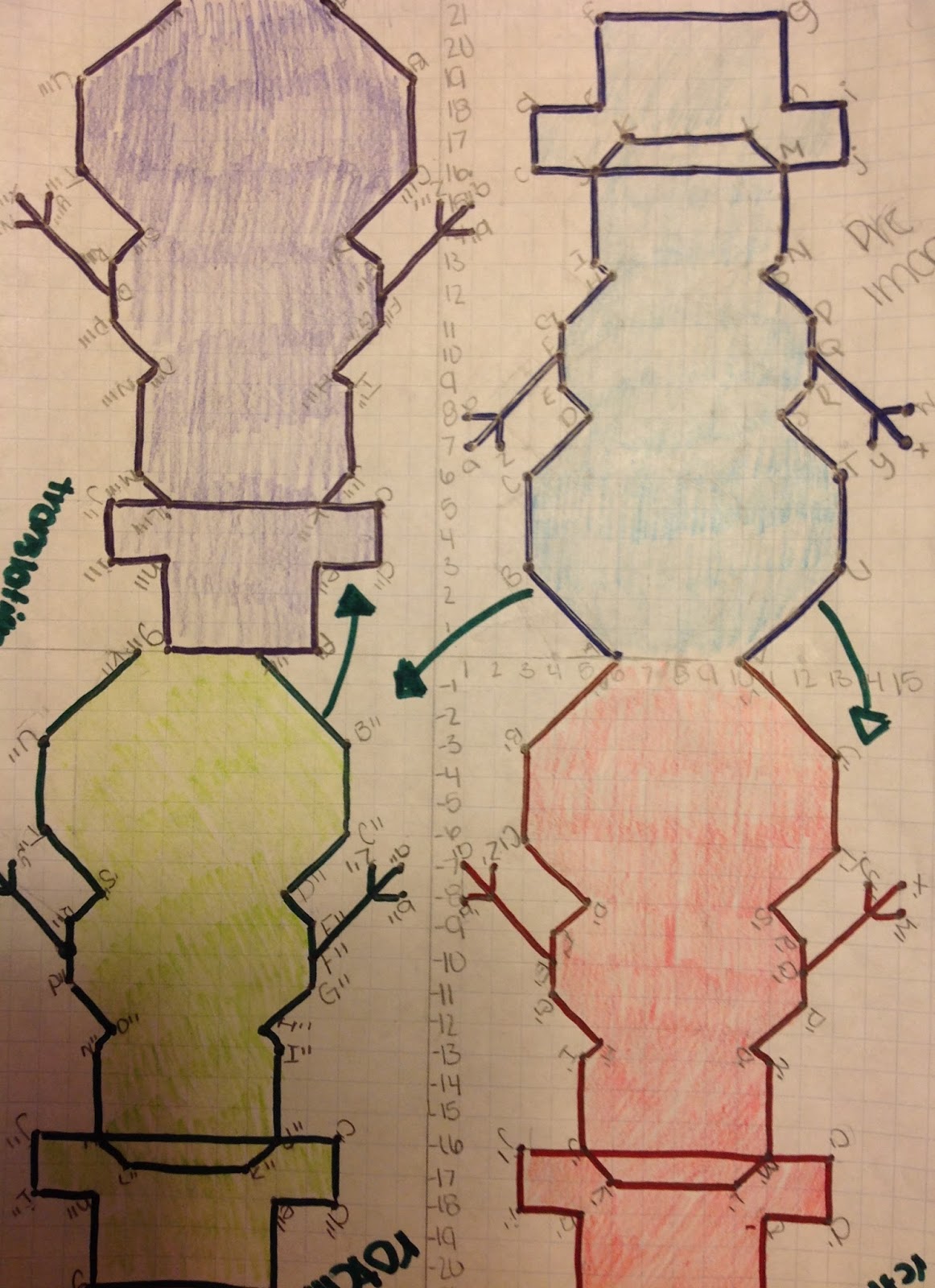


We had our winter theme. This student did all of her transformations from the pre-image.


There are all levels of difficulty in these pictures. I told the students to make a picture between 10 and 30 points, but not to go over 30 because that makes it too hard to finish in our 3 1/2  periods.


There were a couple of students who drew pencils and both were different. 


I love these hats!


This student chose boxing gloves.


On this one you really have to look at the points to see what
 the transformations are because it is so symmetrical.


This picture reminds me of a Dr. Seuss illustration.


The emoticons were very popular and hard to draw. This student worked so hard, and had to tape an extra sheet of graph paper to the back for her picture to fit, and then had graph paper with the plastic that wouldn't let her write on it. It was exhausting! She worked so hard I had to post it.


Another emoticons. They call them emo gees or emogees,
 but I don't know how to spell that and either does spell check.


Nice candy canes, they ate some while they were working.


There is always a clown in every class and here he is. 
His last transformation is not correct but he made me laugh 
and was creative.


Hope you enjoyed these. Have a wonderful holiday season.

Til next time,

Jan


Sunday, December 28, 2014

Transformations Summative Assessment Project

My pre-algebra classes just finished their unit on transformations. They loved the graphing and finding something that 8th graders love to do right before winter break is worth its weight in gold! I found a mini-project that Pam at pperfectsquares shared on transformations. When I saw it, I knew I wanted to make it a summative assessment for my students. So I added a few things to Pam's mini-project and I think turned out to be a great assessment for my kids. Their homework the night before was to create the picture and write down the ordered pairs. I didn't tell them it was going to be part of their assessment so those that did their homework had a head start.


Picture Transformation Assessment

               Your summative assessment for transformations will be an in class project.


  • You will need to draw a pre-image of a picture that has 10 or more points. The pre-image should have detail to it and not just be a picture of a shape or letter like we did in class. 
  • Your pre-image should be completely inside one of the quadrants on the coordinate plane. It does not matter which quadrant you start in. It is your choice. Use your imagination when deciding on a picture and impress me!
  • Draw you pre-image and place points at all of the vertices. List the points and ordered pairs on the transformation summative activity chart.
  • Next you will accurately translate, reflect and rotate your image. You may do this in any order that you want. All points should be listed accurately with a title above it so I can determine if your transformations are correct.
  • Each image should have an arrow showing the direction that the image is moving,(remember we drew arrows), as well as color coding the image and ordered pairs.
  • You will have 2 days to complete this in class. (This actually took 3 1/2 days. We have 45 minute periods.) They will be left in class and passed back on day two. They may not leave the room. Remember to document all of the transformations and label the vertices correctly. Make sure to look at the rubric if you have questions.
   Here are some examples of their final products.
I love this one!

Very creative and neatly done.


Beautiful.


This student worked so hard on her picture and getting her points exact. 
She wanted to give up and try an easier picture but I kept encouraging her. 
She did a great job and was so proud of herself!
As you can see, she went above and beyond the expected 10 points:D

Nicely done.


I like the color coding on this one.


   You know what this student was thinking about.


This is a great picture but this student did not list the transformation or show arrows to depict the movements. Still it is so pretty I had to show you.

I've included the documents for the lesson below. I'm not the greatest at writing rubrics so it isn't the best. Feel free to change it and send me a copy. If you do, that would be awesome.


Enjoy! This is the last post of this year. Where did 2014 go???
Til next year,
Jan

Thursday, June 19, 2014

The beginning of my journey to Standards Based Grading

      Today I finished my training sessions on Standards Based Grading. How do I write about 4 full days of training and work? Hard to do but I'll try my best.

Gina (left), me (center), and Mike (right), working hard at SBG training. These are two of my amazing colleagues from my school.

     Where to start. Hmmmm... So what have I learned about Standards Based Grading?
  • Do grades reward working or learning? Grades should determined by academic performance only.  I never really questioned my grading policies before. It makes sense to me now that the grades I was giving were not a true picture of my students knowledge. It was so inaccurate because homework was a completion grade and that does not show what my students do or do not understand.
  • Behavior is important and should be communicated to parents and dealt with in another way. It should not be something we add or subtract from a grade. Effort or just being a nice kid should not earn you a better grade. Just as your students who have challenging behaviors should not get a lower grade. Grades are not for sale. Bringing in a box of Kleenex does not show me how a child has improved their ability to factor  (or fill in the blank.).Grades reflect knowledge that can be shown through evidence.
  • You  need clear standards and all assessments should be consistent with the standards.We need to communicate clearly to our students through rubrics what the objectives are. Something we have decided to do is to place all the learning standards for the unit we are working on in each math classroom and refer to them everyday throughout the unit. We are not just going to place them on the board daily but have all the standards for the unit instead of just one or two on the board. We want them to see the big picture everyday of the unit. We did create a generic rubric that we are going to tweak for each of our standards. This is still a work in progress. 
  • Group grades for group work should not be used. Again students should only be graded on their individual knowledge that can be shown through evidence. Grading students lower for work that others do not do or giving a student who does nothing a higher grade is not a true reflection of their knowledge. Group work is absolutely a valuable learning tool and should not be eliminated.
  • Anything that can be copied should not be graded. We have decided not count homework as part of the grade but we will keep track of it. It will appear in our grade book with a weight of zero. That way parents, students and teachers can see what has or has not been completed. Also, when a student wants to retest and has not done homework for the practice, one of the criteria to retest will be to do homework and show us evidence that they are have practiced the targets they want to improve.
  • No more completion grades, only grade assessments. We have decided to have our grades weighted as 20% formative assessments and 80% summative assessments. Some believe that the entire grade should be summative only. We aren't ready for that.
  • Grades are inconsistent from teacher to teacher, so aligning and grading  to the standards gives a true grade of student performance. We have always aligned our tests and work to the standards but now we are switching to Common Core Standards so we need to rewrite the assessments to reflect these standards.
     So there is my brain dump from my training. There was so much more but these are the parts that really resonated with my school. We are in the process of many things and I will share them in later posts. So much to do and so little time. Next week: Geometer's Sketchpad class.

     On a funny note, a teacher from our science department came up to us and said, "Look at this great retest form that _______ Middle School gave me that they use." This was amazing because this school never shares anything unlike my amazing school that shares everything with everyone. I looked at the form and smiled and said, "That's the form that I stole from Sarah at math = love , that Kathryn Smith,one of our reading teachers,  rewrote for me, that I posted on my blog on the Retesting - a new idea for me post.." Too funny.

      And of course, I can't leave without sharing something I love with you. If you have never seen Tarsia puzzles before, you have to download the free program  from Mr Barton Maths that has a wonderful list of puzzles that are already made for you to use. (Do not hit the first download button you see. Read the directions further down.) We use these all the time and the kids love them. You can also create your own puzzles but there are so many I haven't had to do that yet. They are so much fun and look very nice hanging in your classroom. Enjoy!


                                                                       Til next time,

                                                                          Jan


Wednesday, June 18, 2014

Thoughts on formative and summative assessment training and nice a coordinate plane foldable

     Yesterday I finished my training on formative and summative assessments. Everything that I am learning is so different than the way I have graded for years. I am a very traditional teacher and have been using percents forever to grade kids. Unit tests were weighted at 50%, quizzes and 25% with homework being the other 25%. My homework has always been viewed as a learning experience and they were given a completion grade for doing the assignment. The comment from one of our trainers was, "if it can be copied, it shouldn't be graded," hit me like a ton of bricks. I have been placing grades in my grade book for years that is homework I know some of my students copy from each other. After a long discussion with Gina and Mike, two of  my math colleagues at work, we made the decision not to grade homework or give it a effort grade. Wow, I am nervous about that. Are the kids going to do the homework or not?  
      We now grade only on the knowledge the students can demonstrate and our grades will be 4, 3, 2, 1, and 0. The way we need to grade now is a complete shift but it some ways it seems like it will be easier and a much more accurate reflection of what the kids really know.  As a department, we decided to start doing Standards Based Grading next year and the first step is to figure out what our formative and summative assessments will be. We are developing a plan of what all of our changes are going to look like and placing them on our syllabus. I really need time to wrap my head around all of this. I am so glad that my entire department, there are 7 1/2 of us, are jumping in and doing this together! We work well together and will all have the same criteria so that will help. I am so glad I already have been allowing kids to retest, see Retesting a new idea for me, as that is a large part of what we talked about today. I know this is all just ramblings but it is what is floating around in my head. If you've read this far, thanks. Tomorrow we finish the second day of training on Standards Based Grading. I'll keep you posted of our progress.  

     I can't have a post without sharing a foldable with you. This is one of my favorites from last year on the Coordinate Plane. It takes time but there is so much information on here and it's all in one place. The kids really liked making it as well. Click here for the original from   Amy Harrison at teaching in a virtual reality. Her pictures are much better than mine so visit her site. Thanks for sharing Amy!

  
Coordinate Plane  Foldable Cover


middle of foldable

Inside of foldable


Til next time,

Jan


Related Posts Plugin for WordPress, Blogger...